Why Frozen Food Brands Lose Money Despite Growing Sales
Frozen food sales may be growing, but profitability is often lost long before the product reaches the customer. From cold-chain costs and inventory ageing to stock-outs, wastage and quick-commerce margins, discover the hidden operational gaps that quietly erode brand profitability in India's frozen food market.
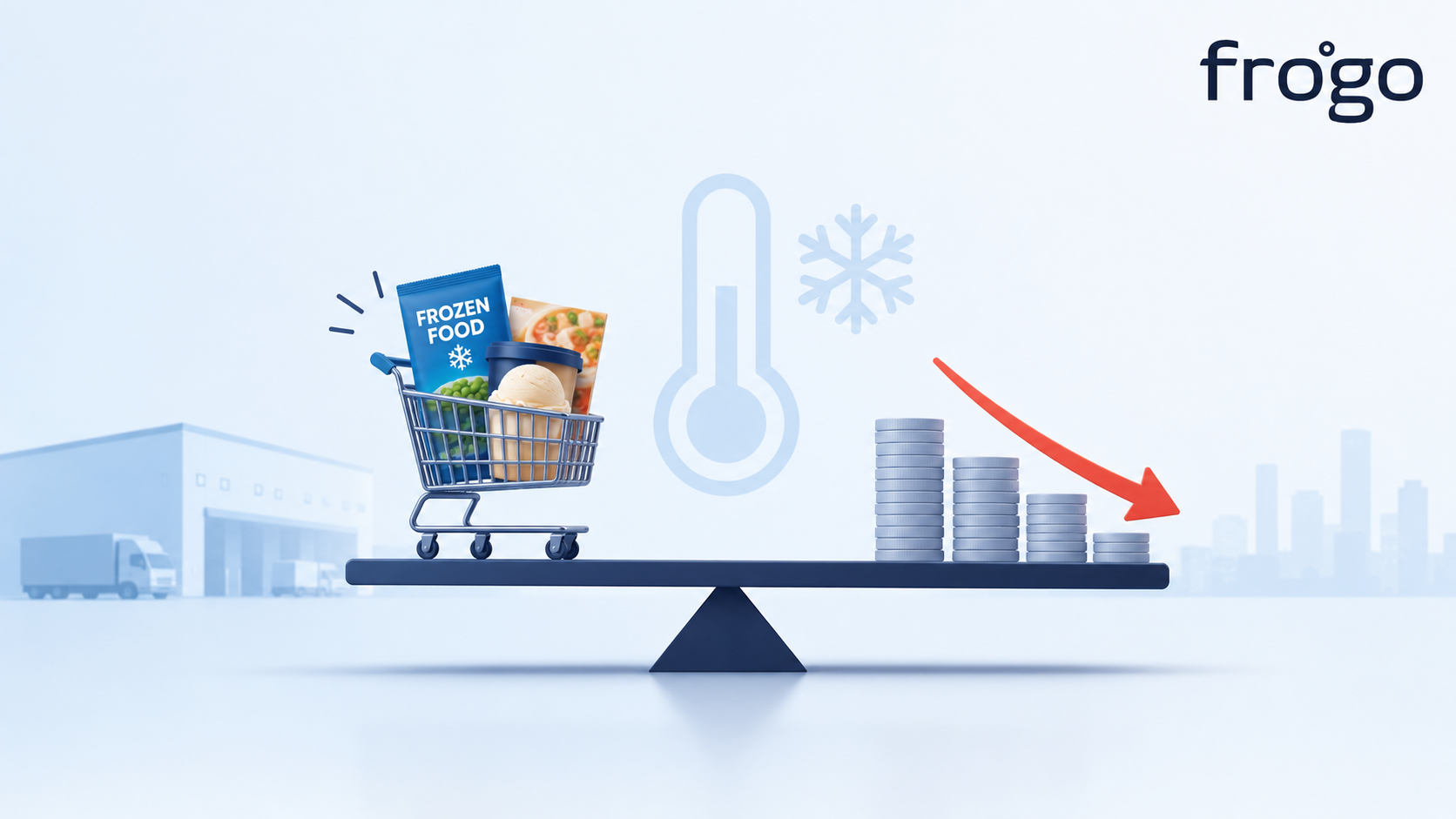
An industry analysis of frozen food brands profitability, quick-commerce economics, inventory inefficiencies and cold-chain fulfilment in India.
India's frozen-food market is growing rapidly. Quick commerce has changed how consumers discover and purchase frozen snacks, ready-to-cook products, ice creams and other temperature-sensitive categories. Brands are expanding their product portfolios, entering new cities and increasing their presence across digital commerce platforms.
Yet, behind this growth lies an uncomfortable business reality: selling more products does not necessarily mean making more money.
A frozen-food brand can report increasing sales, higher order volumes and wider distribution coverage while experiencing declining contribution margins, rising working-capital requirements and increasing operational costs.
The problem is often not the product. It is the economics of getting that product to the consumer.
According to Redseer's March 2026 report on packaged food and quick commerce, frozen ready-to-cook (RTC) sales on India's top three quick-commerce platforms were estimated to have grown from approximately US$200 million in CY2024 to US$376 million in CY2025.
That represents approximately 88% growth in one year.
This is an encouraging signal for frozen-food brands. However, market expansion also introduces more complex distribution networks, inventory requirements and fulfilment economics.
The important question for brand owners is no longer simply how much they can sell.
It is how much of that revenue they can retain after fulfilling the sale.
1. India's Frozen Food Opportunity Is Growing, But So Is Operational Complexity
The Indian frozen-food category is moving beyond traditional retail and institutional consumption.
Quick-commerce platforms have made frozen products more accessible, particularly in urban markets. Consumers can now purchase frozen snacks, vegetables, parathas, momos, ice creams and ready-to-cook products with considerably greater convenience.
Redseer's 2026 analysis estimates the CY2025 frozen RTC market on the top three quick-commerce platforms at approximately US$376 million.
The category composition is also interesting:
| Frozen RTC category | Estimated share |
|---|---|
| Vegetarian products | 47% |
| Products serving both vegetarian and non-vegetarian markets | 35% |
| Non-vegetarian products | 18% |
Source: Redseer, Reinventing Packaged F&B with Quick Commerce, March 2026.
This growth creates opportunities for brands across frozen snacks, vegetables, seafood, meat, dairy-based products and ready-to-cook foods.
However, every additional city, platform and SKU increases the complexity of distribution.
A brand must now manage inventory across multiple locations, maintain temperature integrity, coordinate dispatches, monitor shelf life and ensure consistent product availability.
Growth without operational discipline can become expensive.
2. Seven Reasons Frozen Food Brands Lose Money Despite Growing Sales
2.1 Revenue Growth Is Hiding Fulfilment Costs
One of the most common mistakes in evaluating frozen-food profitability is treating sales growth as the primary indicator of business health.
Consider a brand selling through three quick-commerce platforms across five cities.
Its revenue may increase because:
-
More platforms are listing its products.
-
More cities are becoming accessible.
-
The brand is introducing additional SKUs.
-
Promotional campaigns are increasing order frequency.
But each additional channel and location introduces operational requirements.
These include CFA charges, storage expenses, loading and unloading, transportation, platform-related deductions, inventory transfers and additional working capital.
The result is that sales may increase faster than operational efficiency.
Consider this illustrative example:
| Particulars | Earlier | Expanded |
|---|---|---|
| Monthly sales | ₹50 lakh | ₹80 lakh |
| Gross margin | 30% | 30% |
| Gross profit | ₹15 lakh | ₹24 lakh |
| Fulfilment and distribution costs | ₹5 lakh | ₹10 lakh |
| Contribution after these costs | ₹10 lakh | ₹14 lakh |
Illustrative figures, not reported industry averages.
Sales have increased by 60%, but contribution has increased by only 40%.
The business is growing, but its operational efficiency is deteriorating.
Frozen-food brands must therefore evaluate contribution by city, platform, SKU and distribution channel rather than relying exclusively on consolidated revenue.
2.2 Poor Inventory Rotation Silently Erodes Margins
Frozen products generally have longer shelf lives than fresh products. However, longer shelf life does not mean inventory can be managed without discipline.
Inventory ageing creates several commercial risks:
-
Products approach expiry before reaching consumers.
-
Older batches remain in one location while newer stock gets dispatched elsewhere.
-
Demand forecasting does not reflect actual platform-level consumption.
-
Slow-moving SKUs occupy expensive frozen-storage capacity.
-
Inventory transfers between locations add cost and handling risk.
The challenge becomes more pronounced when brands expand into multiple cities.
A SKU that sells consistently in Bengaluru may move slowly in another market. Promotional campaigns can also create temporary demand spikes that are difficult to forecast.
This is where FEFO (First Expiry, First Out) becomes more important than simply following FIFO (First In, First Out).
A disciplined inventory operation should track:
-
Batch-wise inventory.
-
Manufacturing and expiry dates.
-
Remaining shelf life.
-
Location-wise stock availability.
-
SKU-level inventory ageing.
-
Actual consumption and replenishment patterns.
A brand should not simply ask how much stock it has.
It should ask how much saleable stock it has, where it is located and how quickly it can be converted into revenue.
2.3 Stock-outs and Excess Inventory Are Two Sides of the Same Problem
A frozen-food brand can experience stock-outs and excess inventory simultaneously.
One city may have excess inventory while another experiences repeated stock-outs. A particular platform warehouse may run out of a fast-moving SKU while the same SKU remains available at a nearby CFA.
This creates a double financial impact.
| Operational issue | Commercial consequence |
|---|---|
| Excess stock | Higher holding costs and working capital |
| Stock-outs | Lost sales and lower availability |
| Poor replenishment planning | Emergency transfers and additional costs |
| Incorrect stock visibility | Unnecessary procurement or dispatch |
| Slow-moving SKUs | Lower capacity utilisation |
The problem is not necessarily insufficient inventory.
It is often inventory being positioned incorrectly.
Inventory visibility must translate into inventory availability.
This requires coordination between brand demand planning, CFA operations, warehouse stock and platform-level replenishment.
2.4 Cold-Chain Costs Are Underestimated
Frozen-food fulfilment is fundamentally different from conventional FMCG distribution.
A normal distribution network cannot simply be converted into a frozen-food distribution network by adding refrigeration.
The operating requirements include:
-
Temperature-controlled storage.
-
Appropriate loading and unloading arrangements.
-
Temperature monitoring and exception management.
-
Refrigerated transportation wherever required.
-
Handling discipline during product movement.
-
Documentation and traceability.
These activities have a cost.
Power consumption, refrigeration equipment, backup systems, warehouse utilisation and transportation distances all influence fulfilment economics.
According to the FICCI–Grant Thornton report on India's cold-chain infrastructure, India had approximately 40.22 million tonnes of cold-storage capacity across 8,815 facilities by June 2025.
However, approximately three-quarters of this capacity was used for potatoes.
The report also highlights substantial food losses across horticulture, dairy, meat, poultry and fish supply chains.
This illustrates an important distinction: available cold-storage capacity and commercially usable cold-chain distribution capacity are not the same thing.
A brand needs infrastructure that is suitable for its product, connected to its distribution network and operationally reliable.
2.5 Platform Growth Can Create a False Sense of Profitability
Quick commerce has changed how frozen-food brands reach consumers.
It has also changed the economics of distribution.
According to Bain & Company's How India Shops Online 2025, average order values on quick-commerce platforms increased approximately 40% between FY23 and FY25 (Q1–Q3 comparison).
The report also identified approximately 30% lower cost per shipment in mature quick-commerce catchments, reflecting improvements in order density and operational utilisation.
These are platform-level improvements, not direct cost reductions experienced by frozen-food brands.
The lesson is that platforms are improving their own economics through:
-
Higher order density.
-
Better dark-store utilisation.
-
Larger average baskets.
-
Category expansion.
-
Improved monetisation.
Brands must independently optimise their economics through inventory positioning, order fulfilment, storage utilisation and replenishment efficiency.
There is a difference between being available on a fast-delivery platform and being operationally equipped to serve that platform profitably.
2.6 Fragmented Distribution Increases the Cost of Expansion
Traditional distribution models were largely designed around distributors, stockists and general trade networks.
Frozen-food brands need a more specialised operating model.
As a brand expands into more cities, it must manage different warehouse partners, service levels, inventory systems, temperature standards, dispatch schedules and platform requirements.
The resulting fragmentation can create:
-
Multiple operating procedures.
-
Inconsistent inventory reporting.
-
Different service-level agreements.
-
Poor visibility across locations.
-
Higher coordination and administrative costs.
-
Difficulty maintaining uniform service quality.
The cost of managing the distribution network can become a significant burden even when the product itself has strong demand.
This is particularly relevant for emerging brands that cannot justify building and operating dedicated frozen infrastructure in every market.
The commercial opportunity is to use specialised, multi-city fulfilment partners that provide coordinated operations without requiring brands to replicate their entire infrastructure everywhere.
2.7 Working Capital Gets Trapped in the Supply Chain
Profitability is not just about the difference between revenue and expenses.
It is also about how much capital is required to generate that revenue.
Frozen-food businesses often need to invest in inventory before it is sold. As the distribution footprint expands, the business may need additional stock across multiple locations.
Cash gets trapped in:
-
Inventory sitting in cold storage.
-
Slow-moving SKUs.
-
Stock awaiting platform acceptance.
-
Unreconciled sales and returns.
-
Delayed CFA settlements.
-
Excess safety stock.
A brand may report healthy monthly sales but still face cash-flow pressure because inventory and receivables are growing faster than collections.
The relevant metric is not merely inventory value.
It is inventory productivity.
Brands should track inventory days, stock ageing, receivable days, payable days and cash conversion cycle together.
3. What 2025–26 Industry Research Tells Us
Several independent industry reports reinforce the importance of operational efficiency.
| Research institution | Finding | Business implication |
|---|---|---|
| Redseer, March 2026 | Frozen RTC quick-commerce market estimated at US$376 million in CY2025 | Category growth is attracting competition and distribution complexity |
| Bain & Company, 2025 | Quick-commerce AOV increased approximately 40% | Consumers are placing larger baskets |
| Bain & Company, 2025 | Mature catchments achieved approximately 30% lower cost per shipment | Distribution density and utilisation matter |
| NielsenIQ, April 2026 | Frozen food represented 10% of categories purchased on the latest quick-commerce shopping occasion in its survey | Frozen food has an established presence in online grocery baskets |
| FICCI–Grant Thornton, 2025 | Approximately 40.22 million tonnes of cold-storage capacity | Infrastructure exists, but integration and utilisation remain important |
| MoFPI–CRISIL, June 2026 | Mango losses estimated at 1.94 million tonnes in FY25 | Food supply-chain inefficiency remains a material industry challenge |
Research references:
-
Redseer – Reinventing Packaged F&B with Quick Commerce, 2026
-
MoFPI–CRISIL – Assessment of the Level of Food Processing in India, June 2026
Note: The MoFPI–CRISIL mango-loss estimate concerns fresh mango supply chains, not frozen-food brand wastage. It illustrates broader supply-chain inefficiencies rather than a frozen-category loss rate.
4. The Profitability Framework: What Frozen-Food Brands Should Actually Measure
A growing frozen-food business needs a comprehensive operational scorecard.
Looking at sales, gross margin and inventory value alone will not reveal where money is being lost.
| Performance dimension | Key metric | What it reveals |
|---|---|---|
| Sales | City-wise and platform-wise GMV | Demand and growth |
| Availability | Fill rate | Ability to fulfil demand |
| Service | On-time dispatch / OTIF | Reliability of operations |
| Inventory | FEFO adherence | Expiry and ageing discipline |
| Inventory | Stock accuracy | Reliability of stock records |
| Storage | Space utilisation | Productivity of cold-storage capacity |
| Operations | Dispatch turnaround time | Fulfilment efficiency |
| Quality | Temperature excursions | Cold-chain integrity |
| Financial | Cost per CFT | Storage cost efficiency |
| Financial | Cost per order / dispatch | Fulfilment economics |
| Working capital | Inventory days | Capital tied up in stock |
| Profitability | Contribution per city / SKU | Actual commercial performance |
The most important change is to connect operational performance with financial outcomes.
For example, a 98% on-time dispatch rate is useful, but it becomes commercially meaningful when connected to order fulfilment, platform acceptance, stock availability and contribution margin.
Similarly, high warehouse utilisation is not necessarily good if it is driven by slow-moving inventory.
The objective should not be to maximise every individual metric. It should be to optimise the distribution system as a whole.
5. An Illustrative Frozen-Food Profitability Model
Consider a hypothetical frozen-food brand operating across five cities.
It sells ₹1 crore worth of products every month.
The following example demonstrates how operational leakage can reduce profitability.
| Particulars | Amount |
|---|---|
| Monthly net sales | ₹100 lakh |
| Product cost | ₹60 lakh |
| Gross profit | ₹40 lakh |
| Storage and handling | ₹6 lakh |
| Transportation and distribution | ₹8 lakh |
| Platform and commercial expenses | ₹10 lakh |
| Inventory ageing and damage provision | ₹3 lakh |
| Contribution after listed costs | ₹13 lakh |
Illustrative model only. Not an industry-average cost structure or FroGo client data. Corporate overhead, finance costs and taxes are excluded.
Now consider a hypothetical operational improvement programme.
| Cost component | Before | After |
|---|---|---|
| Storage and handling | ₹6 lakh | ₹5 lakh |
| Transportation and distribution | ₹8 lakh | ₹7 lakh |
| Platform and commercial expenses | ₹10 lakh | ₹10 lakh |
| Ageing and damage provision | ₹3 lakh | ₹2 lakh |
| Total listed operating costs | ₹27 lakh | ₹24 lakh |
| Contribution | ₹13 lakh | ₹16 lakh |
A ₹3 lakh improvement in monthly contribution represents a 23.1% increase over the original contribution, without increasing sales.
This is the opportunity in operational excellence.
The biggest gains do not always come from selling more products. Sometimes they come from reducing the cost and complexity of fulfilling the products already being sold.
6. The Role of an Integrated Cold-Chain Fulfilment Partner
As frozen-food brands scale, their distribution requirements evolve.
They need more than an individual cold-storage facility or a transportation vendor.
They need an operating partner capable of coordinating:
-
Cold storage and inventory management.
-
CFA operations.
-
Batch-wise inventory visibility.
-
FEFO and shelf-life management.
-
Order processing and dispatch.
-
Platform replenishment.
-
Temperature integrity and operational reporting.
-
Multi-city coordination.
This is where an integrated cold-chain fulfilment model becomes commercially relevant.
An asset-light fulfilment partner can help brands access specialised infrastructure and operational capabilities without building and managing every part of the network themselves.
The advantage is not simply avoiding capital expenditure.
It is reducing fragmentation, improving visibility and creating a more predictable operating model.
For growing brands, this can make geographical expansion more manageable and financially disciplined.
7. A Practical Checklist for Frozen-Food Brand Founders
Before expanding into another city or adding another quick-commerce platform, management should evaluate the following:
-
Is there sufficient demand to justify the additional distribution footprint?
-
Is inventory positioned according to actual city- and platform-level demand?
-
Are batch-level stock and expiry details available?
-
Is FEFO followed consistently?
-
Can the fulfilment partner provide reliable temperature records?
-
Are dispatch timelines and platform receiving requirements being met?
-
Is storage capacity being used productively?
-
Are stock-outs and excess inventory measured together?
-
Can the business calculate contribution by SKU, platform and city?
-
Is the expansion improving cash conversion and working-capital productivity?
If these questions cannot be answered with reliable operating data, expansion may be creating more complexity than value.
Conclusion: Selling More Is Not the Same as Earning More
India's frozen-food market is entering an exciting phase.
Quick commerce is making frozen products more accessible. Consumers are discovering new categories. Brands are expanding beyond traditional retail networks, and specialised distribution infrastructure is becoming increasingly important.
But the next phase of competition will not be decided by product availability alone.
It will be decided by which brands can build profitable distribution systems.
A product may have strong demand, attractive pricing and repeat purchases. Yet if inventory is misplaced, fulfilment is fragmented, stock rotation is weak or distribution costs are uncontrolled, growth can become increasingly expensive.
The winning brands will be those that treat cold-chain fulfilment as a strategic business capability rather than an outsourced logistics expense.
At FroGo, we believe the future of frozen-food distribution is not just about keeping products frozen. It is about keeping the entire fulfilment ecosystem commercially efficient, operationally disciplined and ready to scale.
Because in frozen food, the product may generate the sale. But the supply chain determines how much of that sale the business gets to keep.
Frequently Asked Questions
Why do frozen-food brands lose money despite increasing sales?
Frozen-food brands can lose money despite increasing sales because fulfilment, storage, transportation, inventory ageing, stock-outs and working-capital costs can grow faster than revenue. Higher sales do not necessarily translate into higher contribution margins.
What are the biggest costs in frozen-food distribution in India?
Major cost components include frozen storage, electricity, handling, refrigerated transportation, CFA operations, inventory holding, product damage, expiry management and platform-related commercial expenses.
How does quick commerce affect frozen-food profitability?
Quick commerce creates access to more consumers and distribution markets, but requires disciplined replenishment, inventory positioning, dispatch management and platform-level stock visibility. Brands must evaluate profitability separately for each platform and city.
What is the difference between cold storage and cold-chain fulfilment?
Cold storage provides temperature-controlled inventory holding. Cold-chain fulfilment integrates storage with inventory management, handling, order processing, dispatch, transportation and replenishment while maintaining required temperature conditions.
How can frozen-food brands reduce distribution costs?
Brands can improve distribution economics through demand-based inventory positioning, FEFO adherence, better warehouse utilisation, coordinated CFA operations, accurate stock visibility, dispatch optimisation and specialised fulfilment partnerships.
What KPIs should frozen-food brands track?
Important KPIs include fill rate, OTIF, dispatch turnaround time, FEFO adherence, stock accuracy, inventory days, storage utilisation, temperature excursions, cost per CFT and contribution margin by SKU, platform and city.
About FroGo
FroGo is a technology-enabled cold-chain fulfilment partner supporting frozen-food and ice-cream brands with cold storage, CFA operations, quick-commerce fulfilment and multi-city distribution capabilities across India.