Frozen Food & Ice Cream on Quick Commerce in India: Cold Chain Opportunities
Explore India's growing frozen food and ice cream market on quick commerce. Discover 2026 market insights, cold chain logistics, fulfilment challenges and growth opportunities.
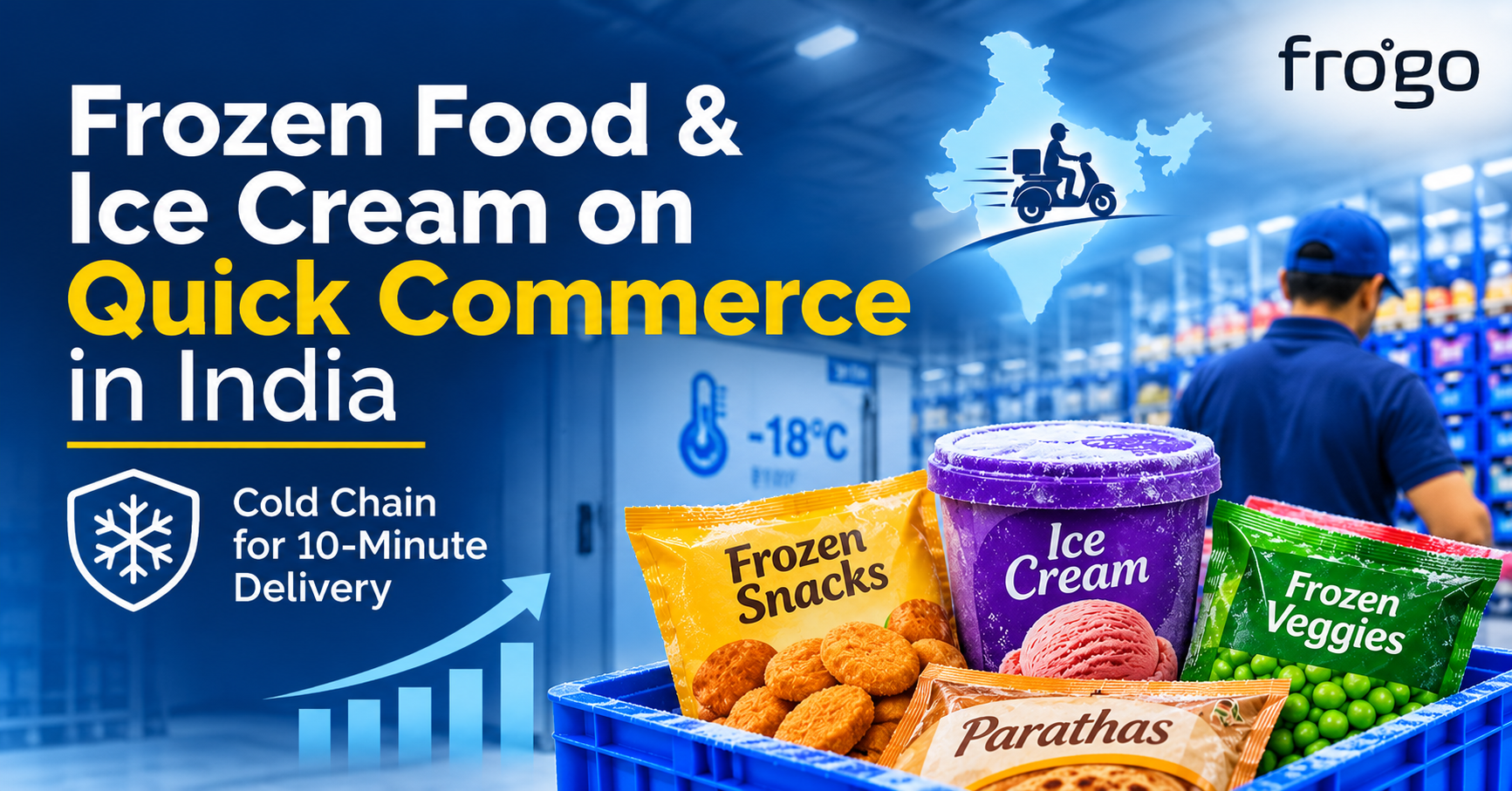
India's frozen food market is entering a new growth phase. Quick commerce is changing how consumers discover, purchase and consume frozen snacks, ready-to-cook meals and ice cream. Behind the convenience of a 10-minute delivery, however, lies a more complex business challenge: building a reliable, scalable cold chain.
For years, frozen food in India was largely associated with supermarkets, modern retail and specialised frozen-food outlets. Consumers typically planned their purchases, visited a retail store and bought products they could store in their home freezers.
That behaviour is changing.
The growth of quick commerce platforms such as Blinkit, Swiggy Instamart and Zepto has made frozen food more accessible. Consumers can now order ice cream, frozen snacks, momos, parathas, vegetables and other frozen products as part of their everyday grocery basket.
For brands, this represents an opportunity to expand distribution, improve product discovery and reach consumers closer to the point of consumption.
For the supply chain industry, however, it introduces a different challenge. Frozen products cannot be treated like conventional FMCG inventory. Their quality, safety and shelf life depend on maintaining temperature integrity across storage, handling, transportation and fulfilment.
The next phase of quick commerce growth in India could therefore create a significant opportunity for organised cold chain operations.
1. India's quick commerce market is creating a new distribution opportunity
Quick commerce in India has evolved from a convenience-led grocery delivery model into a significant retail distribution channel.
According to Redseer's October 2026 report, Think Quick Commerce: Unlocking the $90Bn Opportunity, India's quick commerce market is estimated at approximately US$13 billion in FY2026 and projected to reach US$90 billion by FY2031.
The report identifies two important growth drivers:
-
Increasing household grocery purchases through quick commerce.
-
Expansion into new product categories and larger consumption occasions.
This is important for frozen food brands. As platforms expand their assortment beyond everyday essentials, products that were traditionally purchased during planned grocery trips can increasingly become immediate, need-based purchases.
Frozen snacks for an evening gathering, ice cream after dinner or frozen parathas for breakfast are examples of consumption occasions that fit naturally into this model.
Quick commerce is not simply creating another sales channel. It is changing the timing and context of consumption.
2. Frozen ready-to-cook food is becoming an established quick commerce category
One of the most significant findings in Redseer's March 2026 report, Reinventing Packaged F&B with Quick Commerce, is the growth of frozen ready-to-cook (RTC) products.
The report estimates the frozen RTC category on the top three quick commerce platforms as follows:
| Metric | Market estimate |
|---|---|
| Frozen RTC GMV, CY2024 | US$200 million |
| Frozen RTC GMV, CY2025E | US$376 million |
| Year-on-year growth | Approximately 88% |
| CY2025E market size in INR | ₹3,200 crore |
The category is no longer an experimental assortment on quick commerce platforms. It is becoming an established product segment.
What are consumers buying?
Redseer's research identifies the following broad category composition for frozen RTC on quick commerce in CY2025E:
| Product segment | Share |
|---|---|
| Frozen vegetarian products | 47% |
| Products serving both vegetarian and non-vegetarian markets | 35% |
| Non-vegetarian products | 18% |
Some prominent product categories include:
-
Frozen vegetarian snacks such as aloo tikki, smileys and mini samosas.
-
Frozen peas and vegetables.
-
Frozen momos.
-
Parathas, chapatis and frozen breads.
-
Chicken nuggets and other non-vegetarian snacks.
-
Imported gourmet frozen products.
-
Regional frozen food products.
An interesting insight is that frozen vegetarian snacks alone account for approximately 27% of the category, while frozen peas contribute another 14%.
This indicates that the opportunity is not restricted to premium imported products or specialised frozen-food brands. Everyday Indian food preferences are also driving category adoption.
Note: Redseer's frozen RTC estimate excludes ready-to-eat products and represents its research across the top three quick commerce platforms. CY2025 figures are estimates.
3. Ice cream is emerging as a major quick commerce growth category
If frozen RTC represents the convenience-led side of the frozen food opportunity, ice cream represents its indulgence-led counterpart.
Ice cream has several characteristics that make it particularly suitable for quick commerce:
-
High impulse-purchase potential.
-
Strong seasonal demand.
-
Multiple consumption occasions.
-
Product differentiation through flavours, formats and pack sizes.
-
Strong brand recall and repeat-purchase potential.
According to 1DigitalStack's Summer 2026 Ice Cream on Quick Commerce research, the category is experiencing significant growth.
| Metric | Summer 2026 |
|---|---|
| Ice cream GMV | Approximately ₹1,300 crore |
| Growth over Summer 2025 | Approximately 2.2x |
| Tier 2 and Tier 3 contribution | 41% of GMV |
| Platforms covered | Blinkit, Swiggy Instamart and Zepto |
The findings suggest that ice cream on quick commerce is no longer restricted to premium urban consumers in metropolitan markets.
The growing contribution from Tier 2 and Tier 3 cities indicates that the category is expanding geographically as well.
For ice cream manufacturers, quick commerce offers an additional route to market, greater product visibility and access to consumption occasions that traditional retail may not capture as effectively.
However, ice cream is also one of the most operationally demanding products in the frozen category.
Its quality is sensitive to temperature fluctuations during storage, movement and handling. A seemingly small operational failure can affect product texture, quality and consumer experience.
As the category scales, the importance of a dependable cold chain becomes even greater.
4. Why cold chain is the real growth engine behind frozen food
The growth of frozen food on quick commerce platforms is creating demand for a more specialised supply chain ecosystem.
Unlike ambient FMCG products, frozen products require continuous temperature-controlled handling.
The industry generally operates frozen products at approximately -18°C, subject to product specifications and applicable standards.
Maintaining this temperature is not simply a warehouse requirement. It is an end-to-end operational responsibility.
A typical frozen food supply chain involves:
-
Manufacturer dispatch: Products are prepared, frozen, packed and dispatched under prescribed temperature conditions.
-
Cold storage: Inventory is received, inspected and stored in temperature-controlled chambers.
-
Inventory management: Batch tracking, expiry monitoring and FEFO (First Expiry, First Out) practices help maintain product quality and minimise wastage.
-
Order fulfilment: Picking, sorting and dispatch must be completed without unnecessary exposure to ambient temperatures.
-
Temperature-controlled transportation: Products move through refrigerated vehicles or appropriately validated temperature-controlled arrangements.
-
Receiving and onward distribution: The receiving point must have suitable infrastructure and operating procedures to protect product integrity.
The challenge becomes more complex when a brand operates across multiple cities and serves several quick commerce platforms.
Different demand patterns, order sizes, inventory cycles and service-level requirements require a coordinated operating model.
India's cold storage capacity: The infrastructure paradox
India has made substantial investments in cold storage infrastructure.
The FICCI–Grant Thornton Bharat report, India's Cold Chain Infrastructure: From Storage to a Chain, published in 2026, highlights that as of June 2025:
-
India had approximately 40.22 million tonnes of cold storage capacity.
-
The capacity was spread across 8,815 facilities.
-
Approximately three-quarters of this capacity was used for potatoes.
The report also estimates annual losses of 17–47 million tonnes across horticulture, dairy, meat, poultry and fish products throughout the value chain.
The important insight is that cold storage capacity alone does not create an effective cold chain.
India needs better integration between storage facilities, refrigerated transportation, distribution hubs, technology, traceability and market access.
For frozen FMCG and quick commerce, this translates into a need for specialised operational networks rather than isolated storage facilities.
5. Why quick commerce operations for frozen products are fundamentally different
Quick commerce operations for frozen food cannot simply replicate the processes used for ambient grocery products.
A frozen product requires a different approach to storage, inventory movement, picking, dispatch and quality control.
There are five critical operational dimensions.
A. Temperature integrity
Temperature control must extend beyond the cold storage chamber.
Inbound receiving, put-away, inventory handling, order picking, staging and vehicle loading are all potential points of temperature exposure.
Temperature monitoring and documented SOP adherence are essential to maintaining product quality.
B. Inventory and batch management
Frozen food inventory requires disciplined batch-level tracking.
FEFO-based allocation, expiry monitoring, batch traceability and regular stock reconciliation are critical.
This is particularly important for ice cream and frozen food brands managing multiple SKUs across several cities.
C. Fulfilment efficiency
Quick commerce demands speed, but frozen products cannot be handled at the expense of temperature integrity.
The operational objective should be to minimise unnecessary handling and reduce the time between picking and dispatch.
A well-designed process can improve dispatch efficiency while protecting product quality.
D. Demand forecasting and inventory positioning
Frozen food demand is influenced by seasonality, geography, weather, festivals, consumer preferences and promotional campaigns.
Ice cream demand, for example, can increase significantly during summer, while frozen snacks may have more consistent consumption across the year.
Brands and fulfilment partners need demand visibility to position inventory appropriately, minimise stockouts and avoid excess inventory.
E. Multi-city operational consistency
A brand expanding across Bengaluru, Delhi NCR, Mumbai, Chennai, Kolkata, Hyderabad and other markets needs consistent operating standards.
Warehouse processes, temperature monitoring, inventory accuracy, dispatch performance and reporting should follow a common framework.
The ability to replicate reliable operations across cities can become a significant competitive advantage.
6. The next opportunity: Building an integrated cold chain fulfilment network
The next stage of growth in frozen food and ice cream on quick commerce will require more than additional warehouse capacity.
It will require a connected fulfilment ecosystem.
A scalable model should bring together:
-
Strategically located frozen storage facilities.
-
Reliable temperature-controlled transportation.
-
Standardised warehouse operating procedures.
-
Technology-enabled inventory and batch management.
-
Demand forecasting and inventory visibility.
-
Strong quality assurance and temperature monitoring.
-
City-level fulfilment and distribution capabilities.
An important distinction is emerging between owning cold chain infrastructure and operating an effective cold chain network.
The industry does not necessarily need every brand to build and manage its own warehouses, vehicles and operational teams.
It needs specialised partners who can integrate available infrastructure, technology and people into a dependable operating system.
An asset-light, technology-enabled operational model can help brands expand their geographical reach without having to independently build every component of the supply chain.
This becomes particularly relevant for emerging frozen food brands and established ice cream manufacturers expanding their quick commerce presence.
7. What frozen food brands should look for in a quick commerce fulfilment partner
As the category expands, selecting the right cold chain fulfilment partner will become a strategic business decision.
Brands should evaluate partners on more than warehouse availability or storage rates.
Key evaluation parameters include:
| Evaluation area | What brands should assess |
|---|---|
| Cold storage | Temperature-controlled capacity and reliability |
| Geographic reach | Ability to support multiple cities |
| Inventory management | Batch tracking, FEFO and expiry control |
| Fulfilment | Picking accuracy and on-time dispatch |
| Transportation | Refrigerated movement and temperature monitoring |
| Technology | Real-time inventory and operational visibility |
| Quality assurance | Documented SOPs, audits and exception management |
| Scalability | Ability to handle seasonal peaks and business growth |
The right partner should be able to manage the entire operational process, not merely provide a cold room.
For brands, this can translate into better inventory visibility, more reliable fulfilment, improved service levels and a more scalable route to market.
8. The road ahead: Frozen food is becoming a mainstream consumption category in India
Three trends are likely to shape the future of frozen food on quick commerce in India.
First, category expansion. Frozen snacks, ready-to-cook meals, regional food products and premium frozen offerings will expand the addressable market.
Second, geographical expansion. As quick commerce reaches more Tier 2 and Tier 3 markets, frozen food brands will have opportunities to access new consumer segments.
Third, supply chain specialisation. As volumes increase, temperature integrity, fulfilment efficiency, inventory intelligence and multi-city operating capabilities will become increasingly important.
The opportunity is not limited to selling more frozen products online.
It is about building the operational ecosystem that makes frozen food accessible, dependable and commercially viable at scale.
India's quick commerce story is entering its next phase. Frozen food and ice cream could be among the categories that benefit significantly from this transformation.
But the real competitive advantage will not come from the number of products listed on an app or the number of cold storage facilities available.
It will come from the ability to deliver the right product, at the right temperature, to the right location, consistently.
That is what will separate a frozen food distribution network from a truly dependable cold chain fulfilment operation.
Frequently Asked Questions (FAQs)
1. Is frozen food growing on quick commerce in India?
Yes. Redseer's March 2026 report estimates India's frozen ready-to-cook category on the top three quick commerce platforms at approximately ₹3,200 crore in CY2025E, representing around 88% growth over CY2024.
2. What is the size of India's frozen RTC market on quick commerce?
The frozen ready-to-cook market on quick commerce was estimated at approximately US$376 million (₹3,200 crore) in CY2025E, according to Redseer.
3. How is quick commerce changing the ice cream market in India?
Quick commerce is making ice cream more accessible through immediate delivery, wider digital assortment and greater product discovery. 1DigitalStack's Summer 2026 research estimates ice cream GMV at approximately ₹1,300 crore, around 2.2 times Summer 2025.
4. What temperature is required for frozen food storage?
Frozen food is generally stored at approximately -18°C, depending on product specifications and applicable food safety requirements. Temperature integrity must be maintained throughout storage, handling and transportation.
5. Why is cold chain important for quick commerce operations?
Cold chain ensures that frozen products maintain their required temperature and quality throughout the supply chain. It supports product integrity, shelf-life management, food safety, inventory control and reliable customer fulfilment.
6. What are the biggest challenges in frozen food logistics in India?
Key challenges include fragmented cold chain infrastructure, temperature fluctuations, limited refrigerated transportation, inefficient inventory management, seasonal demand variation, multi-city operational complexity and the cost of maintaining temperature-controlled operations.
7. What should ice cream brands look for in a cold chain logistics partner?
Ice cream brands should evaluate cold storage capabilities, temperature-controlled transportation, batch-level inventory management, FEFO practices, technology integration, fulfilment efficiency, quality assurance and multi-city scalability.
8. Can an asset-light model support frozen food fulfilment in India?
Yes. An asset-light operating model can integrate existing cold storage infrastructure, transportation partners, technology and trained operating teams. This allows brands to expand their distribution network without independently investing in and managing every infrastructure component.
About FroGo
FroGo is a technology-enabled cold chain fulfilment partner for frozen food and ice cream brands in India.
We help brands manage cold storage, quick commerce fulfilment and CFA operations through an integrated, technology-enabled operating model.
Our focus is on making frozen food distribution more reliable, scalable and operationally efficient.
Building the operating network behind India's growing frozen food economy.
Explore FroGo's cold chain fulfilment capabilities.