Why Frozen Food Brands Lose Sales on Quick Commerce (And How to Fix It)
India's frozen ready-to-cook market on quick commerce is growing fast. But getting listed on Blinkit, Zepto or Swiggy Instamart is only half the battle. The real challenge is keeping products available, inventory accurate and orders moving on time.
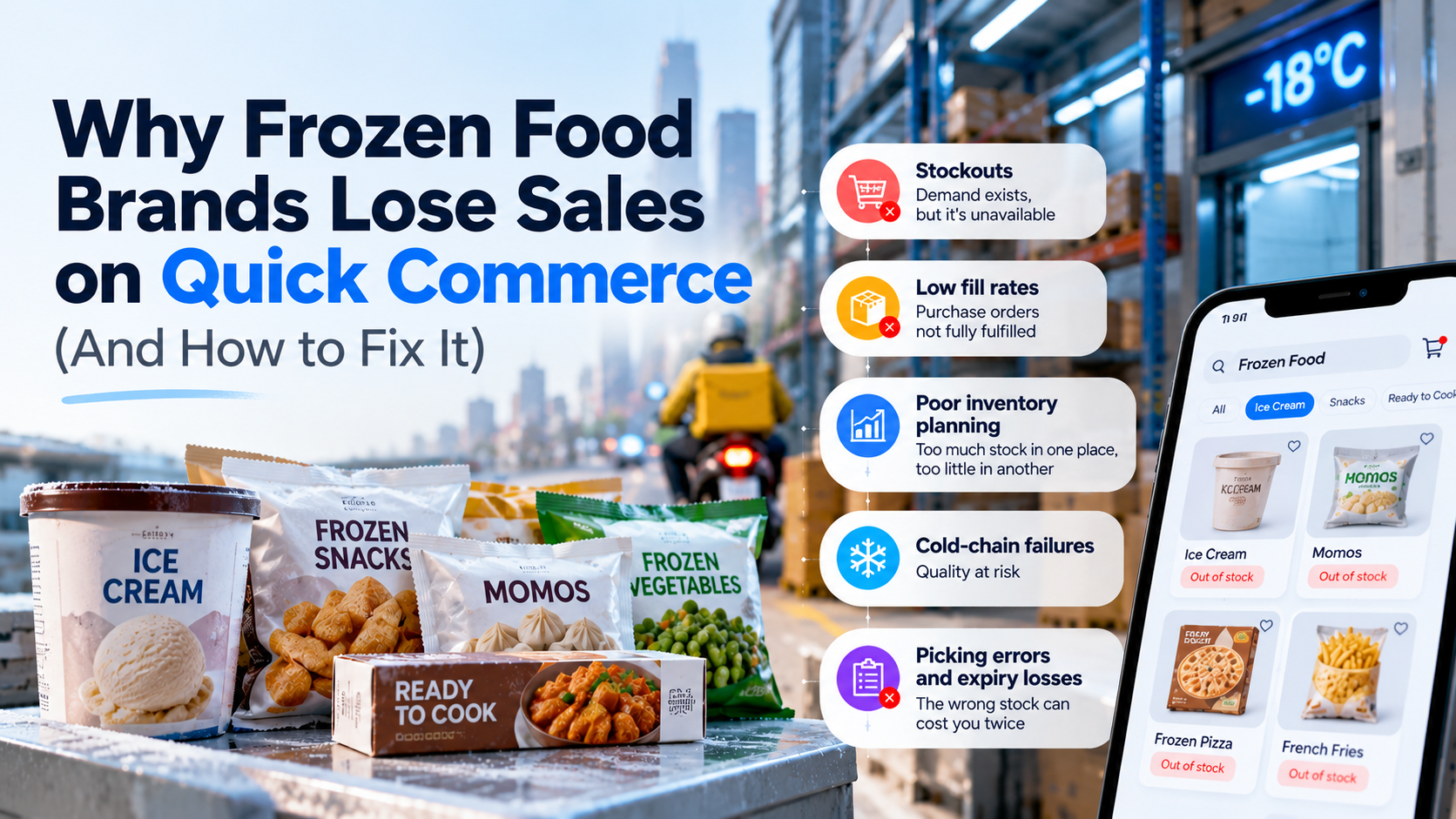
India's frozen ready-to-cook market on quick commerce is growing fast. But getting listed on Blinkit, Zepto or Swiggy Instamart is only half the battle. The real challenge is keeping products available, inventory accurate and orders moving on time.
In March 2026, Redseer Strategy Consultants estimated that India's frozen ready-to-cook (RTC) market on the top three quick-commerce platforms would reach $376 million in 2025, up from $200 million in 2024. That's an estimated 88% year-on-year growth. The figures cover frozen RTC products, not the entire frozen-food or ice cream market. (Source: Redseer, Reinventing Packaged F&B with Quick Commerce, March 2026).
The broader opportunity is growing too. India's quick-commerce market reached an estimated $10–11 billion in gross merchandise value in 2025, according to Bain & Company's How India Shops Online 2026, reported by Business Standard in April 2026. (Source: Business Standard).
For frozen-food and ice cream brands, these numbers point to an opportunity. But growth in the channel doesn't automatically translate into sales for every brand.
A customer might want your product and be ready to order it. If it's out of stock at the nearest dark store, the sale can disappear before your brand gets another chance.
So, why do frozen food brands lose sales on quick commerce—and what can they do about it?
1. Stockouts: The customer wants the product, but it's unavailable
Stockouts are among the most frustrating problems in retail. Demand exists, but the product isn't available where the customer expects it.
For frozen-food brands, the problem can be particularly difficult to spot. There may be enough inventory in the central warehouse, yet the product is unavailable at a specific dark store.
This often happens because replenishment is delayed, inventory is poorly allocated, or local demand changes faster than the replenishment cycle.
How to fix it
-
Track inventory availability at SKU and location level.
-
Identify dark stores with frequent stockouts and strong sales velocity.
-
Set replenishment triggers based on demand, stock cover and lead time.
-
Review inventory allocation before weekends, promotions and seasonal demand spikes.
-
Measure stockout frequency alongside replenishment performance.
The objective isn't to push more stock into the network. It's to put the right products in the right locations.
2. Low fill rates: The warehouse cannot fulfil the entire order
A purchase order is an opportunity to replenish inventory. But receiving the order doesn't mean the brand has fulfilled it.
If the warehouse has less saleable stock than the system indicates, cannot locate the required batch, or runs out of picking capacity, the order may be short-fulfilled.
Repeated short fulfilment can leave dark stores with less inventory than planned.
How to fix it
-
Reconcile purchase orders against available, saleable inventory.
-
Complete goods receipt and system updates promptly.
-
Monitor pending orders and dispatch cut-off times.
-
Use barcode scanning and picking verification where practical.
-
Track fill rate and on-time dispatch separately.
Fill rate measures how much of the ordered quantity is supplied. On-time dispatch measures whether the order leaves within the agreed timeline. A warehouse needs to perform on both.
3. Poor inventory planning: Too much stock in one city, too little in another
Frozen-food demand isn't uniform.
Ice cream demand can rise with warmer weather. Frozen snacks may sell differently across neighbourhoods, weekdays and weekends. Promotional campaigns can change demand quickly, too.
A single forecast for the entire network can hide these local differences. The result is familiar: excess stock in one location and stockouts in another.
How to fix it
-
Forecast demand by SKU and location.
-
Consider historical sales, promotions, seasonality and replenishment lead times.
-
Monitor stock cover and reorder points.
-
Review fast-moving and slow-moving products separately.
-
Track expiry exposure alongside stock availability.
A useful forecast doesn't need to predict every order. It needs to help the team make better inventory decisions before a stockout or excess-stock problem appears.
4. Cold-chain failures: Product availability means little if quality suffers
Frozen products require more than a warehouse and a delivery vehicle. They need the right temperature conditions throughout storage and handling.
The cold chain can be put at risk during receiving, picking, staging, loading or transportation. Poor temperature control can compromise product quality, trigger rejections and create avoidable inventory losses.
India's Ministry of Food Processing Industries describes integrated cold-chain infrastructure as a combination of temperature-controlled storage, freezing, distribution hubs and refrigerated transport. The important point is that these elements need to work together. (Source: Ministry of Food Processing Industries).
How to fix it
-
Maintain storage temperatures according to product specifications, typically -18°C or below for frozen products.
-
Record and verify temperatures at prescribed checkpoints.
-
Pre-cool vehicles as required by operating procedures.
-
Minimise unnecessary exposure to ambient temperatures.
-
Document temperature excursions and escalate them immediately.
-
Quarantine potentially compromised stock until it is assessed and cleared.
A product isn't ready to sell simply because it has reached the warehouse. It must remain within the required conditions throughout the fulfilment process.
5. Picking errors and expiry losses: The wrong stock can cost you twice
Inventory may be physically available but still unusable for an order because of incorrect system records, misplaced cartons or batch-level errors.
Expiry management adds another challenge. If a newer batch is picked while an older eligible batch remains in storage, the warehouse can increase its exposure to ageing and expiry losses.
How to fix it
-
Organise stock by SKU, batch and storage location.
-
Capture manufacturing and expiry dates during receiving.
-
Follow FEFO (First Expired, First Out) for expiry-controlled products and FIFO where appropriate.
-
Verify products and batches during picking.
-
Conduct regular cycle counts and investigate discrepancies.
-
Segregate damaged, expired, returned and quarantined inventory.
Good inventory discipline helps prevent errors before they reach the dispatch dock.
6. Warehouse delays: Stock is available, but the order misses its cut-off
A warehouse can have the right products and still fail to fulfil an order on time.
Picking may take too long. Manpower may be insufficient during peak periods. Orders may not be prioritised correctly. A vehicle may arrive before the shipment is ready.
These delays can affect the next replenishment cycle and leave less time to recover before the next order.
How to fix it
-
Align manpower with expected inbound and outbound volumes.
-
Prioritise orders by committed dispatch cut-off.
-
Organise fast-moving SKUs for efficient picking.
-
Define clear responsibilities for checking, packing and loading.
-
Track order processing time and pending dispatches.
-
Maintain proper shift handovers.
Speed should come from better planning and process discipline—not from skipping checks.
7. Poor visibility: Nobody can explain why sales were missed
When sales data, warehouse inventory, purchase orders and dispatch records sit in disconnected systems, teams may know that a product was unavailable without knowing why.
Was the stock never received? Was the purchase order short-fulfilled? Was inventory allocated to the wrong location? Did dispatch miss its cut-off?
Without reliable data, teams end up fixing symptoms rather than the underlying problem.
How to fix it
Build a common operational dashboard that tracks:
-
SKU-level inventory and stock cover.
-
Stockout frequency by location.
-
Purchase orders received, fulfilled and pending.
-
Fill rates and on-time dispatch.
-
Batch traceability and expiry exposure.
-
Temperature deviations and product damage.
-
Replenishment lead times and recurring exceptions.
A warehouse management system (WMS), supported by disciplined processes and reporting, helps teams spot problems early and take corrective action.
Which metrics should frozen-food brands track?
Start with a small set of operational measures that connect availability, fulfilment and quality.
| Metric | What it tells you |
|---|---|
| Stockout rate | How often a product is unavailable |
| Fill rate | How much of the ordered quantity is fulfilled |
| On-time dispatch | Whether orders leave within committed timelines |
| Inventory accuracy | Whether system stock matches physical stock |
| Stock cover | How long current inventory is expected to last |
| Expiry and damage rate | How much inventory is lost to ageing or damage |
| Replenishment lead time | How quickly stock reaches the required location |
| Cold-chain compliance | Whether required temperature conditions are maintained |
These metrics should be reviewed together. Increasing stock levels may reduce stockouts, for example, but can also increase working capital requirements and expiry exposure.
The goal is to improve availability without compromising product quality or inventory efficiency.
How can a cold-chain fulfilment partner help?
As frozen-food brands expand across quick-commerce platforms and cities, managing storage, inventory, people, technology and refrigerated transportation in-house can become increasingly complex.
A specialised cold-chain fulfilment partner can help coordinate these activities through:
-
Temperature-controlled warehousing.
-
Inventory management and batch traceability.
-
FIFO/FEFO-based picking processes.
-
Purchase-order fulfilment and dispatch coordination.
-
WMS-based inventory visibility and reporting.
-
Operational monitoring and exception escalation.
At FroGo, we work with frozen-food and ice cream brands to manage the operational infrastructure behind their quick-commerce growth.
Our focus is on helping brands keep inventory visible, protect product quality and fulfil orders reliably across their operating network.
Because generating demand is only half the job. The other half is making sure the product is available, in the right place, at the right time.
Scaling a frozen-food or ice cream brand on quick commerce? Connect with FroGo to explore cold-chain warehousing and fulfilment solutions for your business.
Frequently Asked Questions
Why do frozen-food brands lose sales on quick commerce?
Common causes include stockouts at dark stores, low purchase-order fill rates, inaccurate inventory, delayed replenishment, picking errors and cold-chain failures. Brands can address these problems through better demand planning, inventory visibility and disciplined fulfilment operations.
How can frozen-food brands reduce stockouts on Blinkit, Zepto and Swiggy Instamart?
Brands should monitor SKU-level availability, establish replenishment triggers, forecast demand by location, maintain accurate inventory records and track recurring stockouts. The appropriate solution depends on whether the problem originates in inventory planning, warehouse execution or transportation.
What is a good fill rate for quick-commerce fulfilment?
A fill rate measures the quantity supplied against the quantity ordered. The target should be defined in the brand's service-level agreement with its platform or fulfilment partner. Brands should also track on-time dispatch separately, because a complete order that leaves late still misses its timeline.
How should frozen-food inventory be managed?
Frozen-food inventory should be recorded at SKU, batch and location level, with manufacturing and expiry dates captured wherever required. FEFO should be followed for expiry-controlled products, and storage temperatures should remain within product specifications.
What should brands look for in a cold-chain fulfilment partner?
Look for temperature-controlled storage, reliable inventory systems, batch traceability, FIFO/FEFO processes, accurate purchase-order fulfilment, on-time dispatch, transparent reporting and the ability to support your target cities and volumes.