AI-Driven Cold Chain Logistics: How Artificial Intelligence Is Transforming Frozen Food Supply Chains
AI-driven cold chain logistics is the use of artificial intelligence, machine learning, IoT sensors and predictive analytics to monitor, manage and optimise the storage, transportation and distribution of temperature-sensitive products.
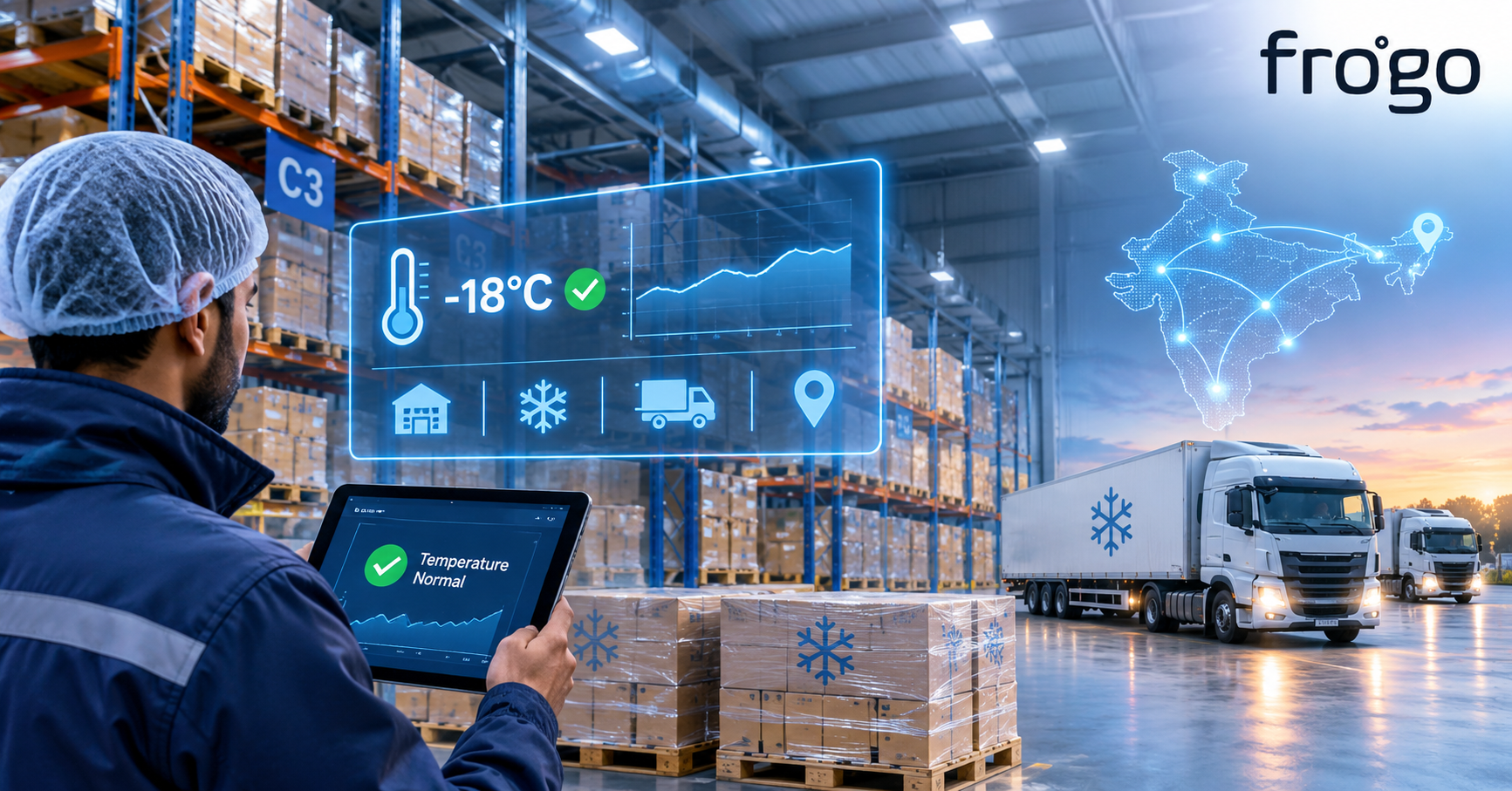
AI-driven cold chain logistics is the use of artificial intelligence, machine learning, IoT sensors and predictive analytics to monitor, manage and optimise the storage, transportation and distribution of temperature-sensitive products. It enables businesses to move beyond traditional temperature monitoring towards predictive decision-making, helping prevent temperature excursions, forecast demand, optimise inventory, reduce food wastage and improve warehouse and transportation efficiency.
In industries such as frozen food, ice cream, dairy and pharmaceuticals, maintaining temperature integrity across the supply chain is critical. AI-driven systems analyse real-time temperature readings, inventory movements, equipment performance, weather conditions and demand patterns to identify potential risks before they disrupt operations.
For India's growing frozen food and quick-commerce ecosystem, AI-driven cold chain logistics represents an important shift: from simply maintaining cold storage infrastructure to building intelligent, connected and data-driven supply chains.
The real advantage is not just knowing what is happening inside a warehouse or refrigerated vehicle. It is being able to anticipate what might happen next and take corrective action before it affects product quality, inventory availability or business performance.
1. Why Does Cold Chain Logistics Need Artificial Intelligence?
Cold chain logistics is fundamentally different from conventional warehousing and transportation.
A temperature deviation in an ambient warehouse might create a relatively minor operational issue. In a frozen food supply chain, the same deviation can compromise product quality, shelf life and consumer experience.
Consider an ice cream distribution operation.
A shipment moves from a manufacturing facility to a cold storage warehouse, then to a distribution centre and eventually to a retail or quick-commerce fulfilment network. Every movement introduces potential risks:
-
Temperature fluctuations during loading and unloading.
-
Delays in transportation and receiving.
-
Incorrect inventory allocation.
-
Expiry-related losses due to poor stock rotation.
-
Refrigeration equipment failures.
-
Demand fluctuations resulting in stockouts or excess inventory.
Traditional systems generally depend on predefined thresholds, periodic inspections and manual intervention.
AI introduces a more predictive approach.
By analysing historical transactions, temperature readings, inventory movements, equipment performance, weather conditions and demand patterns, AI models can identify patterns that may not be immediately visible to warehouse managers.
The objective is simple: move from reactive cold chain management to predictive and intelligent operations.
2. The Growing Opportunity for Intelligent Cold Chain Logistics in India
India's cold chain ecosystem is expanding alongside the growth of organised food retail, frozen food consumption, pharmaceuticals and quick commerce.
According to the Ministry of Food Processing Industries, India had 8,815 cold storage facilities with a combined capacity of approximately 402.18 lakh metric tonnes as of June 2025, as reported by IBEF.
The Ministry's Integrated Cold Chain and Value Addition Infrastructure scheme also reported 409 approved projects as of June 30, 2026.
The commercial opportunity is expanding too. IBEF, citing IMARC Group, estimates India's cold chain logistics market at approximately ₹1.09 lakh crore in 2025, with an estimated value of ₹1.32 lakh crore in 2026.
These numbers point towards an important development: India's cold chain challenge is no longer only about creating infrastructure. It is also about improving the productivity, utilisation and intelligence of that infrastructure.
As the number of warehouses, SKUs, distribution points and transactions increases, manual decision-making becomes increasingly difficult to scale.
AI can help bridge this gap.
3. Seven Ways AI Is Transforming Cold Chain Logistics
3.1 Predictive Temperature Monitoring and Excursion Prevention
Temperature monitoring has always been central to cold chain operations.
However, conventional monitoring systems primarily generate alerts when temperatures cross predefined thresholds.
AI can take this a step further.
By analysing temperature histories, refrigeration performance, door-opening frequency, ambient weather conditions and equipment behaviour, predictive models can identify early warning signals.
For example:
-
Detecting unusual temperature fluctuations before a critical threshold is breached.
-
Identifying refrigeration equipment showing signs of deteriorating performance.
-
Predicting temperature recovery times after loading operations.
-
Identifying warehouses or transportation routes with recurring temperature deviations.
IoT sensors provide the data, while AI helps interpret it and identify potential risks.
For frozen food and ice cream businesses, this can improve product integrity, reduce avoidable losses and strengthen quality assurance.
3.2 AI-Powered Demand Forecasting and Inventory Planning
Demand forecasting is one of the most commercially valuable applications of AI in cold chain logistics.
Frozen food and ice cream consumption is influenced by several variables:
-
Weather and temperature.
-
Seasonality and festivals.
-
Regional consumption preferences.
-
Promotions and pricing.
-
Quick-commerce demand patterns.
-
Historical sales and stock availability.
Traditional forecasting models may struggle to account for these interconnected variables.
AI-powered forecasting can combine historical sales, weather patterns, platform-level demand and other relevant signals to estimate demand at SKU, city and warehouse levels.
For example, an anticipated heatwave in Bengaluru or Delhi could indicate higher ice cream demand. Inventory allocation and replenishment plans can then be adjusted before demand materialises.
This creates opportunities to:
-
Reduce stockouts.
-
Improve inventory availability.
-
Reduce excess and ageing inventory.
-
Improve warehouse capacity planning.
-
Align procurement and replenishment with expected demand.
For frozen food brands operating across multiple cities, better forecasting can translate directly into improved working capital efficiency.
3.3 Intelligent Warehouse Management and FEFO Optimisation
Cold storage is an expensive operational environment.
Every square foot of warehouse space, every refrigeration unit and every additional movement of inventory contributes to operating costs.
AI can help improve warehouse productivity through intelligent inventory placement, automated picking recommendations and storage optimisation.
Some potential applications include:
-
Predicting SKU movement and identifying fast- and slow-moving inventory.
-
Recommending optimal storage locations based on picking frequency.
-
Optimising picking routes to minimise movement inside cold rooms.
-
Identifying ageing inventory and potential expiry risks.
-
Recommending First Expiry, First Out (FEFO) stock allocation.
-
Improving space utilisation and inventory rotation.
An intelligent warehouse management system can connect batch-level inventory information with order demand and shelf-life data.
This is particularly important for frozen food businesses, where stock visibility and expiry management directly affect profitability.
3.4 Predictive Maintenance of Refrigeration Infrastructure
Refrigeration is one of the most critical and energy-intensive components of cold chain infrastructure.
An unexpected compressor failure or refrigeration system breakdown can expose substantial inventory to temperature risk.
Traditional maintenance is often either preventive, based on predefined schedules, or reactive, after equipment failure.
AI-powered predictive maintenance can analyse:
-
Compressor operating patterns.
-
Energy consumption.
-
Temperature recovery performance.
-
Refrigerant pressure and other equipment parameters.
-
Historical breakdown and maintenance records.
By identifying abnormal patterns, AI systems can help maintenance teams intervene before equipment failures become critical.
The benefits include improved equipment availability, reduced emergency maintenance and better protection of temperature-sensitive inventory.
3.5 Intelligent Route Planning and Transportation Optimisation
Transportation is not simply about choosing the shortest distance between two locations.
Cold chain transportation must balance delivery schedules, traffic, vehicle capacity, temperature requirements, fuel consumption and product handling conditions.
AI-powered route optimisation can incorporate multiple variables to recommend better transportation plans.
For example, a system could:
-
Predict traffic-related delays.
-
Recommend alternative routes.
-
Optimise vehicle utilisation.
-
Consolidate shipments where operationally feasible.
-
Predict delivery delays.
-
Coordinate warehouse dispatch schedules with receiving windows.
When integrated with real-time vehicle tracking and temperature-monitoring systems, these capabilities can provide better shipment visibility.
The result is a more coordinated transportation network with improved delivery reliability and potentially lower operating costs.
3.6 AI-Driven Energy Management
Cold storage facilities consume significant energy to maintain controlled temperatures.
Energy efficiency is therefore both an environmental priority and a direct contributor to operating economics.
AI can analyse refrigeration loads, historical consumption, occupancy, ambient temperatures and equipment performance to identify opportunities for optimisation.
Potential applications include:
-
Identifying abnormal energy consumption.
-
Predicting refrigeration loads.
-
Optimising equipment operating schedules.
-
Detecting inefficient cooling cycles.
-
Identifying opportunities to improve energy consumption per unit of stored inventory.
A 2025 study published in Energy Informatics explored an IoT-based cold chain monitoring and energy management system using machine learning optimisation techniques. In its simulated experimental environment, the proposed system reported approximately 20% lower energy consumption compared with the traditional system.
This is a research result, not a guaranteed commercial saving. However, it illustrates the potential of combining sensor intelligence with predictive analytics.
3.7 Computer Vision and Automated Quality Control
Computer vision can bring another layer of intelligence into cold chain warehouse operations.
AI-enabled cameras can potentially support:
-
Pallet and carton identification.
-
Barcode and label verification.
-
Packaging damage detection.
-
Loading and unloading verification.
-
Visual inspection of warehouse processes.
-
Detection of process deviations.
When integrated with warehouse management systems, computer vision can reduce dependence on manual verification and improve operational traceability.
For high-volume frozen food distribution networks, even small improvements in receiving and dispatch accuracy can have a meaningful cumulative impact.
4. The Technology Stack Behind AI-Driven Cold Chain Logistics
AI does not operate independently. Its effectiveness depends on the quality of the underlying data and the systems that generate it.
A connected cold chain ecosystem typically combines five technology layers.
1. IoT and sensor infrastructure
Temperature sensors, humidity sensors, energy meters, vehicle trackers and equipment monitoring devices generate real-time operational data.
2. Warehouse Management Systems (WMS)
WMS platforms capture inventory, batch information, expiry dates, stock movements, picking, receiving and dispatch transactions.
3. Enterprise and supply chain integration
ERP, order management and transportation systems connect warehouse operations with procurement, manufacturing, sales and distribution.
4. AI and predictive analytics
Machine learning models analyse historical and real-time data to identify patterns, forecast demand, predict operational risks and recommend decisions.
5. Control towers and decision intelligence
Centralised dashboards provide operational visibility across warehouses, vehicles, inventory and distribution networks, enabling teams to monitor exceptions and take corrective action.
The real value emerges when these systems communicate with one another.
A temperature alert without shipment context is incomplete. A demand forecast without inventory visibility is difficult to execute. An inventory dashboard without expiry intelligence cannot fully support stock optimisation.
The objective should be an integrated, data-driven operating ecosystem.
5. Why Data Quality Matters More Than AI Adoption
There is a tendency to treat AI as a standalone technology investment.
In reality, AI is only as useful as the data and processes supporting it.
Imagine deploying a sophisticated demand forecasting model when warehouse inventory records are inaccurate, batch information is incomplete and dispatch transactions are recorded inconsistently.
The model may produce forecasts, but operational teams will struggle to act on them.
The same problem applies to temperature intelligence. Sensors that are poorly calibrated, inconsistent data capture and fragmented monitoring systems can undermine predictive models.
Businesses looking to implement AI-driven cold chain logistics should first establish:
-
Standardised digital operating procedures.
-
Accurate SKU and batch-level inventory records.
-
Reliable temperature data capture.
-
Consistent inward and outward transaction recording.
-
Integration between WMS, ERP and transportation systems.
-
Clearly defined operational performance metrics.
AI should strengthen operational discipline, not compensate for its absence.
6. How FroGo Is Building the Technology-Enabled Cold Chain Operating Layer
At FroGo, we believe the future of cold chain logistics lies in bringing infrastructure, technology and operational execution together.
FroGo is a technology-enabled cold chain fulfilment partner for frozen food and ice cream brands in India.
Our services include cold chain warehousing, quick-commerce fulfilment, CFA operations, inventory management and distribution support.
Through our proprietary FroGo Pulse technology ecosystem and warehouse management capabilities, we focus on digitising the operational activities that form the foundation of intelligent cold chain management.
These include:
-
Inbound and outbound inventory workflows.
-
Batch-level inventory tracking.
-
Manufacturing and expiry date management.
-
FEFO-based picking processes.
-
Scan-based warehouse operations.
-
Purchase order fulfilment.
-
Inventory reconciliation.
-
Operational dashboards and reporting.
Our operating model is designed to give brands better visibility into inventory, warehouse execution and fulfilment performance.
This digital foundation is important because the next stage of cold chain evolution will require more than digitised transactions.
It will require predictive intelligence.
The opportunity is to progressively connect operational data with demand forecasting, temperature intelligence, warehouse optimisation and decision-support capabilities.
For brands scaling frozen products across quick-commerce platforms, distributors and multiple cities, this convergence of technology and operational execution can become a significant competitive advantage.
Explore FroGo's cold chain warehousing capabilities and cold chain fulfilment services to understand how an integrated operating model supports frozen food businesses.
7. What Should Frozen Food Brands Measure in an AI-Enabled Cold Chain?
AI adoption should ultimately be measured through business outcomes, not the number of dashboards or algorithms deployed.
The following metrics can help businesses evaluate the effectiveness of their cold chain operations.
| Operational area | Key performance indicator |
|---|---|
| Temperature integrity | Temperature excursion frequency and duration |
| Inventory | Inventory accuracy and stock variance |
| Shelf life | Expiry-related losses and FEFO compliance |
| Fulfilment | Fill rate and on-time dispatch |
| Warehouse | Space utilisation and picking productivity |
| Transportation | On-time delivery and vehicle utilisation |
| Energy | Energy consumption per unit of storage |
| Equipment | Refrigeration downtime and maintenance cost |
| Financial performance | Cost per order and cost per CFT |
A well-designed AI system should help improve these metrics through better prediction, visibility and decision-making.
The ultimate objective is not to make cold chain operations more technologically complicated. It is to make them more predictable, efficient and profitable.
8. The Future: From Connected Cold Chains to Autonomous Supply Chains
The evolution of cold chain logistics will happen in stages.
Stage 1: Digitisation
Replacing manual records with digital inventory, warehouse and transportation systems.
Stage 2: Connectivity
Connecting warehouses, vehicles, sensors, ERP systems and distribution networks.
Stage 3: Intelligence
Using AI to forecast demand, identify risks, optimise inventory and predict equipment failures.
Stage 4: Autonomous decision-making
Enabling systems to recommend and, within approved operational boundaries, execute corrective actions with minimal manual intervention.
For example, a future intelligent cold chain system could detect an anticipated demand surge, recommend inventory redistribution, identify the most suitable warehouse, optimise transportation schedules and alert operations teams to potential capacity constraints.
Human oversight will remain essential, particularly for food safety, product quality and operational accountability.
But the role of people will increasingly shift from monitoring individual transactions to managing exceptions, validating decisions and improving the overall supply chain.
Conclusion: Intelligence Will Become the Next Competitive Advantage in Cold Chain Logistics
India's cold chain industry is entering a new phase of growth. Expanding frozen food consumption, organised retail and quick commerce will increase the complexity of managing temperature-sensitive products across increasingly distributed networks.
Infrastructure will remain important. Refrigeration, warehouses and temperature-controlled transportation are indispensable.
But infrastructure alone will not create a sustainable competitive advantage.
The next generation of cold chain leaders will be those who combine physical infrastructure with accurate data, predictive intelligence and disciplined execution.
AI-driven cold chain logistics is not simply about automating warehouses or installing smarter sensors. It is about building a supply chain that can anticipate, adapt and continuously improve.
At FroGo, we see technology as an integral part of building that operating ecosystem for India's frozen food and ice cream brands.
The future of cold chain logistics will not just be colder. It will be smarter.
Frequently Asked Questions (FAQs)
1. What is AI-driven cold chain logistics?
AI-driven cold chain logistics uses artificial intelligence, machine learning, IoT sensors and predictive analytics to improve the storage, transportation and distribution of temperature-sensitive products. It helps businesses forecast demand, monitor temperature conditions, optimise inventory and identify operational risks.
2. How does AI improve cold chain management?
AI improves cold chain management by analysing real-time and historical operational data. It can predict temperature deviations, optimise warehouse inventory, improve demand forecasting, identify equipment failures and recommend efficient transportation routes.
3. What is the role of IoT in AI-driven cold chain logistics?
IoT sensors collect temperature, humidity, equipment and vehicle data across the supply chain. AI models analyse this information to identify patterns, predict potential disruptions and support proactive decision-making.
4. Can AI reduce food wastage in cold chain logistics?
Yes. AI can help reduce avoidable food losses through better demand forecasting, expiry prediction, FEFO-based inventory allocation, temperature monitoring and improved distribution planning. Actual results depend on data quality, implementation and operational execution.
5. How is AI used in frozen food and ice cream logistics?
AI can support demand forecasting, temperature monitoring, batch-level inventory management, expiry tracking, warehouse picking, refrigeration maintenance and transportation optimisation. These applications help protect product quality and improve fulfilment efficiency.
6. What is the difference between traditional and AI-driven cold chain logistics?
Traditional cold chain systems primarily monitor conditions and respond to predefined alerts. AI-driven systems use historical and real-time data to predict risks, identify patterns and recommend decisions before problems escalate.
7. How can frozen food brands implement AI in their supply chains?
Brands should begin by digitising warehouse operations, establishing accurate inventory and batch records, integrating temperature sensors, connecting ERP and WMS platforms, and creating reliable operational dashboards. Predictive analytics and AI can then be introduced progressively.
8. Does FroGo provide AI-driven cold chain logistics services?
FroGo provides technology-enabled cold chain warehousing, CFA operations, inventory management and quick-commerce fulfilment for frozen food and ice cream brands. Its FroGo Pulse ecosystem supports digital warehouse and supply chain workflows, creating a foundation for increasingly intelligent cold chain operations.
9. Why is AI important for India's cold chain industry?
India's expanding cold storage infrastructure, growing frozen food consumption and increasing demand for quick-commerce fulfilment are making supply chains more complex. AI can help businesses improve infrastructure utilisation, inventory accuracy, energy efficiency, temperature monitoring and distribution planning.